What Artemisia Gentileschi Teaches Us About Critiquing Power Through “Radical” Art
Dip discusses the ways that Artemisia Gentileschi’s paintings exemplify resistance to domination so well that it turns the canvas into a refusal–while grappling with the impotence of such a “powerful” move.


Columbus’s Museum of Art has had an exhibit of Artemisia’s works from the Naples era of her career up since Halloween. It’s interesting to see how they frame it; the museum page calls her “an icon of feminist art history,” which is definitely true. However, given the existence of enemy feminisms, it is always good to look deeper into the invocations of that language.
Photo by Tucker Monticelli on Unsplash
I’ll put my proverbial cards on the proverbial table by saying that I’m quite inspired by her. Regardless, or potentially because of that, a feminist framing from these folks, when combined with a description of Artemisia’s Hercules and Omphale (c. 1635–37) that includes a line about it being a “gender-bending [...] emasculation” of Hercules by Omphale is… suspect. But maybe that’s because I pull more from non-trash feminist traditions. My style is much more in line with J. Rogue and g and Selma James than… whomever else is crafting the other takes.
Those two moments in the exhibition description draw me towards conversations I’ve started to cohere in my Four Horsemen of Bullshit essay. For the uninitiated, the reason that I find this enemy (sounding) feminism framing useful is twofold: 1) it allows onlookers to start and/or build an understanding of the depths Artemisia was plumbing in her work while 2) realizing that those depths are materially lacking without any genuine counter-systemic force to back it up.
Even the emphasis on “rescuing” and “conservation” (a beloved term from the Powers That Be that always has a colonial stink to it) undergird the non-emancipatory approach taken. I don’t expect museums to be radical. Who knows; maybe I’ll hear about the events they have coming up, and my take will get more texture to it. I do, however, feel like it’s worthwhile to point out the specific ways in which they’re not radical, especially when they use “radical” language out of context.
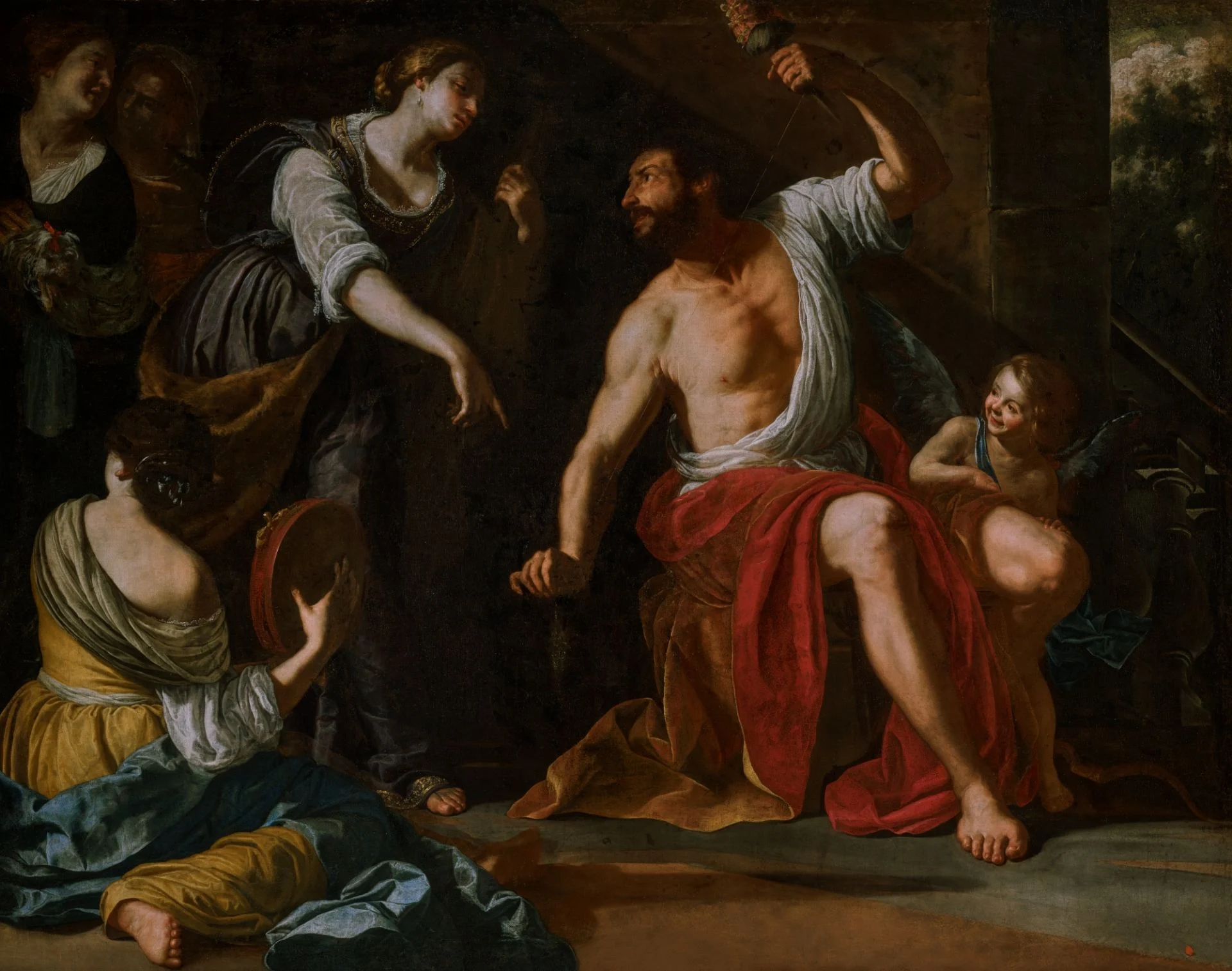
Looking at Hercules and Omphale, domination is explored here, but it reads as of a particular kind, whereby “dues” have to be “paid” for those with lower class positionality (but not too low, especially vis a vis other identities intersecting with class) to get a “seat at the table.”
The painting depicts a section of Hercules’s story where, in the aftermath of killing Iphitus (one of the Argonauts), Omphale, the Queen of Lydia, turned him into an indentured servant. This relationship is surprisingly less antagonistic than what is depicted in Bathsheba (c. 1636‒37) or, iconically, Judith Slaying Holofernes (c. 1612–1613).
This lack of antagonism strikes me as particularly compelling for the sake of tracing the contours of Artemisia-as-feminist. There is a way in which subsequent invocations and readings of this piece as flipping gender norms are presaged and challenged; I'm clued into this by other figures in the frame, especially the yellow-dressed figure in the foreground at the bottom left, and the cherubic figure on Hercules's lap. These two seem to be playing a role in 1) tracing labor/performance expectations (as it could be well-argued that gender is about who does what labor) and 2) setting the mood away from antagonism, respectively. The foreground figure is kneeling, a foot splayed out while attending to Omphale, while the cherub plays a similar role for Hercules.
These details, rather than pointing to a crude inversion, emasculation, or other such things, show the situational nature of strength, with an eye on the role of social structures in these formulations; the implied romance points towards this. Even a (demi)god can be held accountable to their actions. More bitingly, the fabricated nature of gender’s performative components is revealed. If certain kinds of work that are often “reserved” for (a narrow conception of) women can be (and is) done by those who exist otherwise, what does that mean for how those performances and labors are imbricated with/in gender? In the wider context of her works, especially Bathsheba and Judith Slaying Holofernes, gender is made out to be–with varying levels of viscerality–a negotiation.
This understanding, and any other radical castings of Artemisia must be read against the desire to “exceptionalize” her, though she may be exceptional. A cursory read of the materiality of her work, both in the sense of the things she used to make it–like the hyper-expensive lapis lazuli–alongside the actual funding and commissioning of that work, point to Artemisia being a critic of her machine at best, rather than truly railing against it in a transformative way. I mean, there were two versions of this work, and the first one (not pictured above) was meant for… the King of Spain.
Even if one sticks to “textual” analysis, it is clear that this moment in time is only that. From Hercules's indenture being temporary to his eventual Olympian ascension, there is an admission that these sorts of “reversals” are often temporary. I’d add that this is due to the lack of structural changes alongside the individualization of struggle, whereby the alpha and the omega is a defiant act. Those things are critical (people need to do stuff), but they can’t be seen as the movement to change the current way things are in toto.
So, I hesitate to make a claim like “my goat has been co-opted,” in light of that–even if there aren’t many popping artists right now who’re navigating power with a similar verve.
This loops back into the feminist discussion from earlier. If one describes feminism as a theory of domination, with patriarchy as its ocular nexus, then Artemisia fits the bill. If one assumes that feminism has to be a theory of practice, whereby everything should be actively moving or inspiring movement towards the end of that domination in concrete terms, her art fails the test. That doesn’t mean that it ain’t good or that folks should necessarily feel bad about thinking that it’s good. It just points to the need for theorizing to be paired with actualizing.
This is to say: the exposure of fault lines is the power the paintings hold, even against the grain of their materiality. However, the map is not the territory; one cannot arrive just by pointing out the destination. Without heeding the directions through action, the destination of liberation will always remain remote. A slight warmth is that if someone who was, by all intents and purposes, a part of the machine can call it out, those of us who are marginalized by it in multiple ways can afford to lean into our boldness. As the saying goes (and should be read with a recentering of slavery and bonded labor), “we have nothing to lose but our chains.”


